Dental Bridges – New Braunfels, TX
Connecting the Gaps In Your Smile

Are you struggling with missing one or several teeth in a row? You aren’t the only one. About 178 million Americans are battling tooth loss. Fortunately, several tooth-replacement options can help tackle the issue. If you have multiple consecutively missing pearly whites, then a dental bridge may be the ideal solution for you. With this restoration treatment, you can easily link the gaps between your teeth so that you can show off your beautiful smile again. Read on or reach out to our office today to learn more about what to expect from a dental bridge in New Braunfels!
Why Choose Gruene Family Dental for Dental Bridges?
- Completely Customized Dental Restorations For Each Patient
- Durable, Reliable, & Long-Lasting Dental Materials
- Expert, Friendly, & Dedicated Dental Staff
What Is a Dental Bridge?
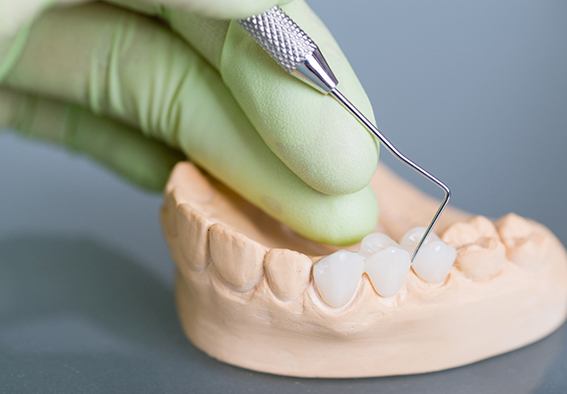
Unlike a dental crown, which restores the structure and function of a damaged tooth, a dental bridge is designed to replace one or several consecutive teeth that are completely missing. This restoration option typically utilizes the same ceramic dental material, giving it a lifelike appearance. It is made up of two dental crowns that are placed on either tooth surrounding the gap which is connected via prosthetic teeth (pontics) to fill in the space between. Once it’s been fitted, a fixed traditional bridge won’t be able to be removed without the help of your dentist.
Types of Dental Bridges
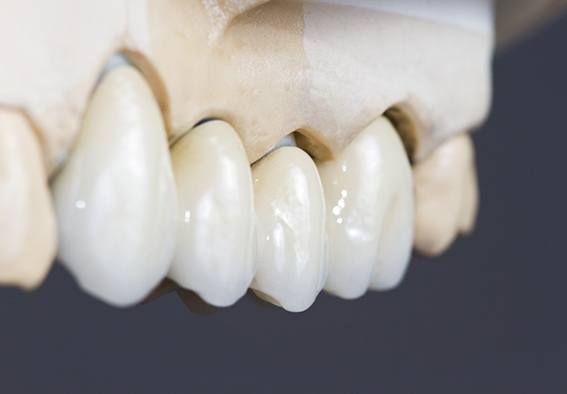
Our team is more than happy to provide two kinds of dental bridges: traditional and implant-supported. Here’s what you can expect from either tooth-replacement solution:
Traditional Dental Bridge
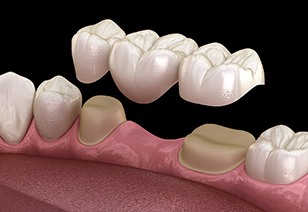
If you’re missing one or several teeth in a row, then traditional dental bridges are the simplest way to close the gaps in your smile. For this to work, your dentist will place a dental crown on either side of the gap and “bridge” the space with pontics. We only use the highest-quality dental materials to provide the most durable and natural-looking results for a complete smile.
Implant Bridge
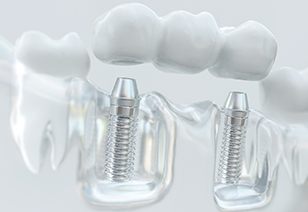
Unlike traditional dental bridges, which use nearby healthy teeth for support, implant bridges are directly anchored to the jawbone via titanium posts. Not only will this offer increased stability, but your restoration will also have a much longer lifespan and provide a stronger bite force. This option is also ideal for patients who are missing more than three or four teeth in a row, as a traditional bridge can become less stable the further it extends.
The Benefits of Getting a Dental Bridge

Dental bridges provide a wide variety of essential benefits for your smile, including:
- Completely personalized treatment to address your specific dental needs
- Restoring your bite to make eating more comfortable
- Preventing misalignment problems from happening
- A restoration solution that can last 10 years or more with proper care
Dental Bridges FAQs
Can Dental Bridges Get Cavities?
Being artificial, dental bridges can’t actually get cavities; they lack the required enamel. Only the natural teeth connected to them can decay.
Remember: dental bridges rely on your existing teeth to remain stable. These “abutments” could get cavities if they aren’t well-maintained, becoming loose and wobbly over time. The result would be an increased risk of bridge failure, which ruins your pretty and restored smile.
Given these facts, you should always try to clean under and around your bridge. Your treatment results won’t last very long otherwise.
Is Getting a Dental Bridge Painful?
In reality, it isn’t painful to get a dental bridge. Dentists take steps to ensure the treatment process is smooth and easy for you.
One such precaution is pre-treatment numbing. The dentist will numb your smile with an anesthetic before preparing your teeth, ensuring their work doesn’t hurt. The most you might feel is a slight pressure as the team operates.
You’ll only face discomfort (if any) after your bridge has been placed. At that time, your “abutments” – the natural teeth securing your appliance – may feel sore for a few days. You needn’t worry, though; this ache is easily managed with over-the-counter medicine.
Can You Take a Dental Bridge Out?
Whatever you may have thought, you can’t take a dental bridge out on your own. It’s meant to be a semi-permanent part of your smile; only a dental professional can remove it in emergencies.
You see, dental bridges aren’t like dentures or similar removable prosthetics. They secure themselves to your mouth with “abutments” – nearby natural teeth – or dental implants. That being the case, they remain firmly bound to your smile; you can’t take them out at will. You’ll have to rely on a dentist if and when your bridge should be removed.
Do Dental Bridges Look Natural?
Today’s dental bridges look incredibly natural and lifelike. Indeed, almost no one will notice that these devices aren’t natural parts of your smile.
Such naturalness stems from modern bridge materials. Today, the most common ones are ceramic and zirconia – tooth-colored substances that can match your smile’s shade. That means the typical bridge will blend seamlessly with surrounding teeth, without drawing unwanted attention to itself.
Of course, that a bridge fits your smile well is also crucial. Dentists will tailor the device so that it sits in your mouth comfortably and won’t fall out over time.
- Once placed, your bridge should blend in with the rest of your smile quite well.
- Bridges made from metals like gold and silver obviously won’t look natural, but they’re typically only used for teeth that aren’t visible in the smile.
- With bridges, you won’t need to worry about your prosthetic falling out, like you might with a denture.